

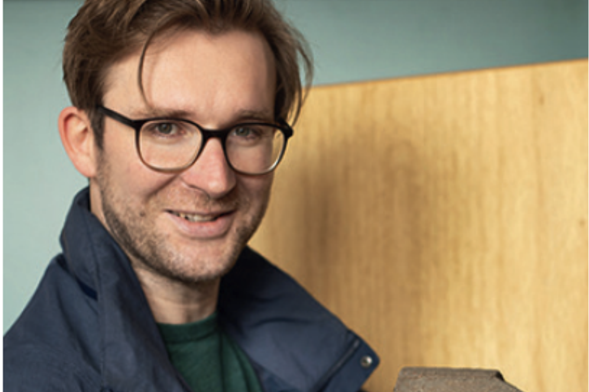
Martin Kutzschbach began his studies in Geosciences at Kiel University in 2007, continued at ETH Zurich, and completed his M.Sc. at the University of Potsdam in 2014 with a thesis in the field of Applied Mineralogy on the corrosion of silicate glasses.
In his doctoral dissertation entitled “The Effect of Tetrahedral Boron on the Boron Isotope Fractionation Between Tourmaline and Fluid – Improving Tourmaline as a Petrogenetic Indicator”, carried out as a joint project between the Technical University of Berlin and the GFZ German Research Centre for Geosciences (2014–2017), he focused on the experimental synthesis of tourmaline, boron isotope fractionation, and its petrological applications.
He succeeded in demonstrating how the geochemically important element boron is incorporated into the tetrahedral site of the tourmaline structure and what consequences this has for the ^10B/^11B isotope fractionation. His work on this topic began with detailed studies of mineral synthesis, investigating how metastable intermediate products influence the final reaction products, and culminated in the successful synthesis of a structurally and chemically complex mineral such as tourmaline, characterized by numerous substitution mechanisms and exceptional chemical variability.
His research on tourmaline subsequently extended to petrological applications, particularly the study of fluid flow and fluid–rock interaction during Alpine metamorphism. In doing so, he gained experience across the full spectrum of scientific research, ranging from demanding experimental work and the analysis of synthetic products to the characterization of natural samples and the interpretation of these data using geochemical models.
During this project, his curiosity about improving analytical techniques was sparked. Since the light elements boron and lithium remain difficult to analyze even with modern analytical methods, he devoted his first years as a postdoctoral researcher at TU Berlin to establishing an in situ laser ablation laboratory.
Establishing such a laboratory requires considerable time and effort. It demands not only perseverance in overcoming technical and scientific challenges but also patience in dealing with the administrative obstacles that often accompany the creation of new research infrastructure. Yet building such facilities is invaluable for our institutes. Research and education depend on them, and investments in this infrastructure yield long-term scientific benefits.
The resulting analytical capabilities—for example, measuring trace element distributions in minerals at the micrometre scale, determining δ³⁴S isotope fractionation in sulfides, and performing in situ Rb–Sr geochronology on micas and feldspars—enable a wide range of applications.
He demonstrated these possibilities through studies of elemental uptake by microorganisms, radium incorporation into barite, arsenic partitioning between pyrite and fluids, and the resetting of the Rb–Sr isotope system in metamorphic micas.
The application of laser ablation Rb–Sr dating to standard minerals such as feldspar and mica has enormously expanded the possibilities for reconstructing the geological history of rocks in detail. Of particular interest is the retrograde evolution of magmatic and metamorphic rocks, which can be resolved in great detail when combined with petrological and crystal-chemical data.
He demonstrated that micas can often preserve their original Rb–Sr isotope systematics, making it possible to date detrital material in sedimentary rocks and thereby obtain information on sediment provenance and depositional age. His current research includes the indirect dating of organisms from the deep biosphere and the post-magmatic evolution of pegmatites.
His most recent investigations have shown that laser ablation Rb–Sr dating yields reliable ages for various mica species, in agreement with independent isotope systems, and that it is now also possible to date the ammonium feldspar buddingtonite, which had previously resisted reliable geochronological analysis. This will make it possible to determine diagenetic ages in carbon-rich sedimentary rocks.
The geological history of pegmatites can thus be reconstructed—from their emplacement at around 1.7 Ga through multiple overprinting events at approximately 1.5 Ga, 500 Ma, and finally 200–300 Ma.
Since 2024, Martin Kutzschbach has been working at Goethe University Frankfurt in the Geology and Paleoenvironmental Research Group and at the FIERCE Center for Isotope Geochemistry in a DFG-funded position within the project “Completing the Detrital Record of Clastic Sediments by in situ Rb/Sr Dating of Mica.” For the DMG, he is also co-organizer of the FIERCE 2025 doctoral course.
He received the Paul Ramdohr Award in 2017.
— Gerhard Franz · Berlin