

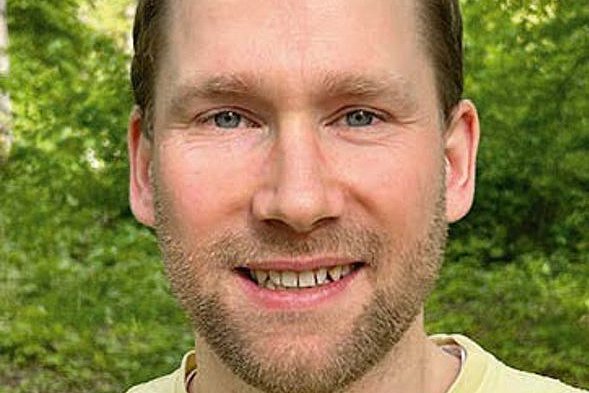
Johannes Buchen studied Mineralogy at Johannes Gutenberg University Mainz and completed his doctoral thesis with distinction at the Bavarian Research Institute of Experimental Geochemistry and Geophysics (Bayerisches Geoinstitut) in Bayreuth in 2018. From October 2018 to August 2021, he was a Postdoctoral Scholar at the Seismological Laboratory of the California Institute of Technology (Caltech, USA), followed by a position as Postdoctoral Research Assistant at the University of Oxford (UK). Since May 2023, he has been Junior Professor at the Bayerisches Geoinstitut.
Dr. Buchen is a mineral physicist who investigates the structure and properties of the Earth's deep interior using high-pressure experiments in diamond anvil cells.
One of his main research objectives is the measurement of seismic wave velocities in deep Earth materials. These data are essential for the interpretation of seismic observations, which provide the most important source of information about the Earth's interior.
During his doctoral research, Johannes Buchen investigated whether water in minerals of the mantle transition zone can be detected through seismological observations. Wadsleyite, one of the dominant minerals in the transition zone, is capable of incorporating several weight percent of water into its crystal structure. It has therefore long been assumed that this region contains large amounts of water and that water dissolved in wadsleyite would reduce seismic wave velocities. Johannes Buchen succeeded in measuring the complete elastic tensor of hydrous wadsleyite under high-pressure conditions, an achievement that is remarkable in itself given the low symmetry of its crystal structure. He further demonstrated that, contrary to previous assumptions, structurally bound water has only a minor effect on seismic velocities within the transition zone. However, variations in the strength of seismic reflections at the 410 km discontinuity can be used to detect the presence of water. This represents a groundbreaking discovery that will enable a much more detailed understanding of the distribution of water within the deep Earth.
In collaboration with seismologists, Johannes Buchen investigated a series of models to explain the reflection of seismic waves at the 410 km discontinuity beneath the North Atlantic. His work showed that only very specific chemical compositions are consistent with the observations. Above a water-rich transition zone, the upper mantle must contain an iron-rich layer. This study demonstrates how seismic observations, combined with mineral physics models, can reveal the physical and chemical conditions of the Earth's interior.
In his recent contribution to the AGU Geophysical Monograph Series, Johannes Buchen presented the first comprehensive analysis of the effects of mineralogical and chemical variations on seismic velocities in the lower mantle. He developed a new thermodynamic formalism describing spin transitions of iron in lower mantle minerals. Using this new model, he demonstrated that a lower mantle with a peridotitic composition would produce shear-wave velocities that are higher than those observed seismologically. One possible explanation is the presence of SiO₂-rich and iron-poor domains in the lower mantle that remained after crystallization from a global magma ocean. This hypothesis would also explain why the upper mantle appears to be depleted in SiO₂ relative to chondritic meteorites.
The quality and depth of this comprehensive body of work clearly demonstrate that Dr. Buchen has rapidly developed into one of the leading experts in the mineral physics of the deep Earth.
—
Hans Keppler • Bayreuth