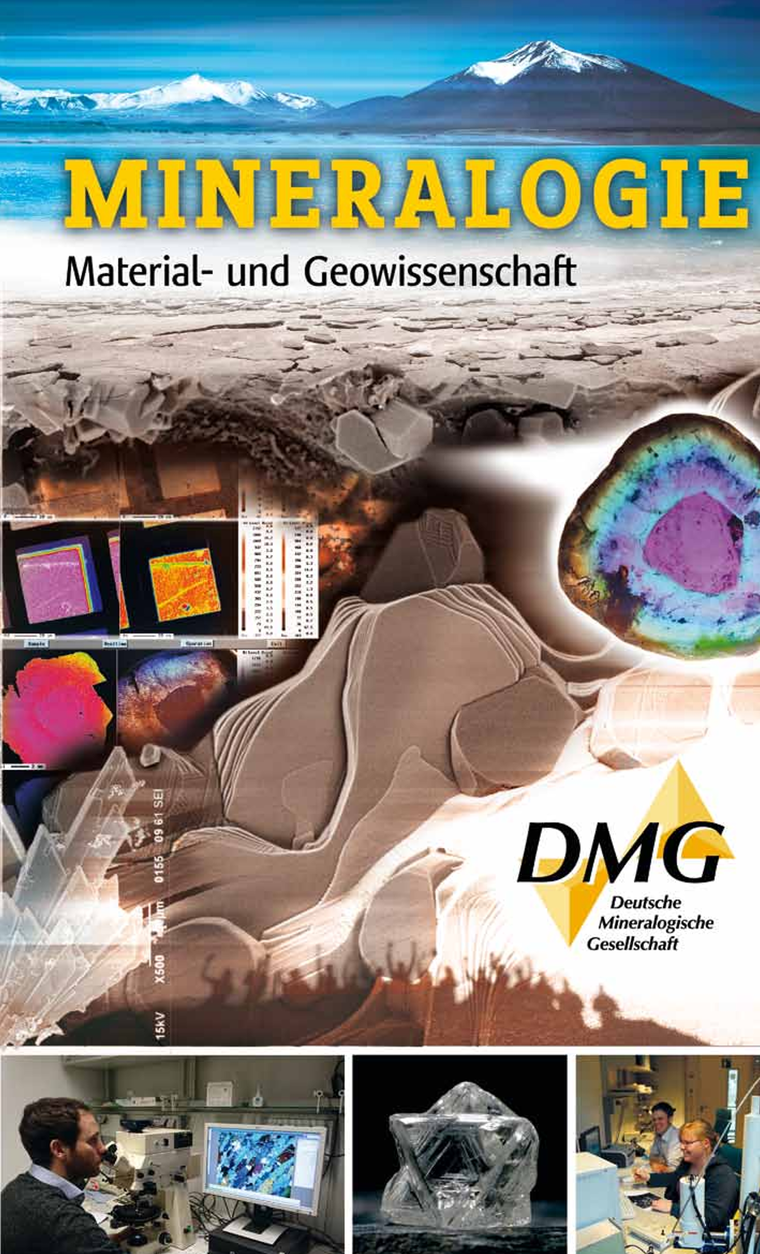
What Is Mineralogy?How mineralogy helps usunderstand our planet
Mineralogy investigates the formation, composition, structure, and properties of minerals and the materials they form. Its scope ranges from the atomic structure of crystals to rocks and geological processes, and ultimately to the structure and evolution of planets.
As a materials-oriented geoscience, mineralogy connects geology, chemistry, physics, and materials science. Mineralogical research helps us understand how our planet works, how natural and synthetic materials form, and how mineral resources can be used responsibly.
One Field – Many Perspectives
Crystallography
How are minerals structured at the atomic level, and how does their structure determine their properties?
Petrology & Petrophysics
How do rocks form and change – from the Earth’s surface to deep within the mantle?
Geochemistry
How are chemical elements and isotopes distributed in minerals, rocks, and geological systems?
Applied Mineralogy
How can mineralogical knowledge be applied to materials, raw materials, the environment, and technology?
Mineralogy: Fascination and Application
Mineralogy extends far beyond the traditional study of minerals and rocks. It provides a foundation for exploring the Earth’s interior and other planetary bodies, as well as for the exploration and use of mineral resources, the development of new materials, recycling, and the investigation of environmental processes.
From battery raw materials and construction materials to ceramics and semiconductors, and from meteorites to rocks from deep within the Earth’s mantle, mineralogical methods help us characterise materials, understand how they form, and make targeted use of their properties.
Discover Mineralogy
Mineralogy connects the exploration of our planet with current questions surrounding raw materials, materials, the environment, and technology. For anyone seeking to understand how natural materials form, how they change, and how we can use them, mineralogy offers an exceptionally diverse field of research.