

Basic Module –Hands-on Mineralogy
The Basic Module offers an engaging and varied introduction to mineralogy. Using a diverse selection of hand specimens, students discover the fascinating world of minerals and rocks: What types of rocks are there, and which minerals are they made of? Covering everything from minerals and rocks to ores and industrial products, the module not only reveals an impressive variety of shapes and colours but, above all, demonstrates how closely mineral raw materials are connected to our everyday lives.
It is often surprising just how many raw materials we encounter every day without even noticing them. A selection of minerals and examples of their everyday applications provides fascinating insights into these connections.
The hand specimens also offer numerous opportunities for exploring individual topics in greater depth in the classroom. A fossil-bearing limestone, for example, can serve as a starting point for discussing the formation and preservation of fossils.
Flint and obsidian illustrate the importance of mineral raw materials for some of humanity’s earliest tools and for making fire during the Stone Age. A polished glass bead, industrial glass, natural volcanic glass, and a corundum crystal provide an illustrative comparison between crystals and glasses of natural and industrial origin. Finally, magnets invite students to experiment for themselves.
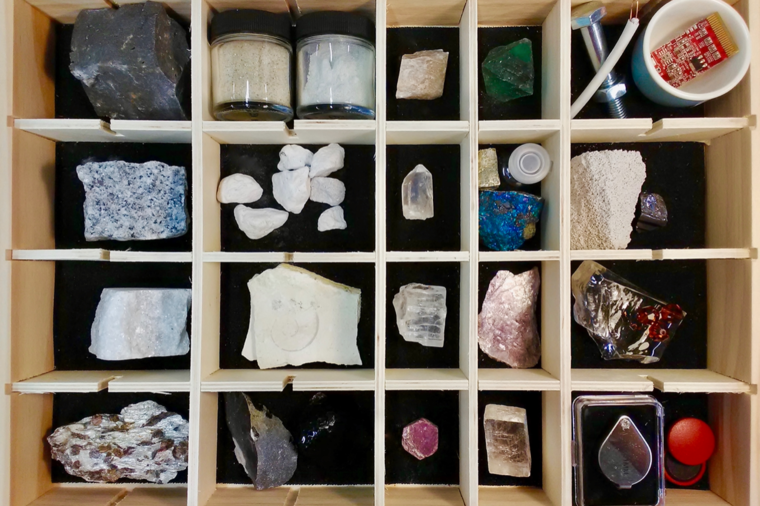
Contents
Core Area:
- Granite, Garnet-Mica Schist, Marble, Basalt, Fossiliferous Limestone, Pumice, Flint, Obsidian, Sand, Clay
- Feldspar, Quartz, Lepidolite, Calcite, Fluorite, Rock Salt (Halite), Corundum
- Bornite (Peacock Ore), Magnetite, Pyrite
Extension (Additional Material for In-Depth Study):
- Ceramics, Steel Screw, Copper Cable, PC Chip, Silicon, Magnets, Industrial Glass, Faceted Glass Beads, Aerated Concrete (Autoclaved Aerated Concrete), Magnifying Glasses (2x)
Case Dimensions: 36.5 cm x 28.0 cm x 7.0 cm
Weight: approx. 2.5 kg
Examples for Use in the Classroom:
Primary Education: Rocks and minerals, formation of the Earth, Stone Age tools, magnetism (magnetic minerals)
Mathematics: Geometric solids
German: Describing objects, their properties, and possible uses
Biology (Grades 9/10): Evidence for evolution (formation of fossils)
Chemistry: Carbon and carbonates (lime cycle)
Science and Technology (Grades 5/6): From raw material to finished product
Geography: Minerals and rocks, the rock cycle, raw materials