

Diversity of Rocks –Investigating and Classifying
The “Diversity of Rocks” module contains three exercise sets with hand specimens that allow students to explore the rock cycle of an initially clay- and sand-rich material step by step.
Through deposition and consolidation, the sediment first becomes a sedimentary rock. As it is transported to greater depths within the Earth, increasing pressure and temperature alter its structure and mineral composition, resulting in the formation of mica schist. Partial melting followed by crystallisation eventually produces granite. If geological processes bring the granite back to the Earth’s surface, weathering and erosion once again lead to the formation of sediments.
By independently examining and classifying the hand specimens, students can directly observe and reconstruct this cycle using the rocks themselves.
The module builds on an idea familiar from everyday life: many students already know that temperature can change the properties and physical state of a substance, for example during the transition from ice to water and water vapour. The rock cycle expands on this understanding: with increasing depth within the Earth, not only temperature but also pressure increases, and both are key factors in the transformation of rocks.
The three exercise sets are complemented by additional characteristic hand specimens. Basalt and pumice illustrate volcanic processes, limestone provides an introduction to the silicate–carbonate cycle, and eclogite demonstrates how rocks change under extremely high-pressure and high-temperature conditions. A particularly unusual addition is suevite, a rare rock formed during a meteorite impact.
The hand specimens therefore provide numerous starting points for exploring further geoscientific topics, ranging from volcanism and weathering to the silicate–carbonate cycle, the use of rocks as construction materials, and the processes associated with meteorite impacts.
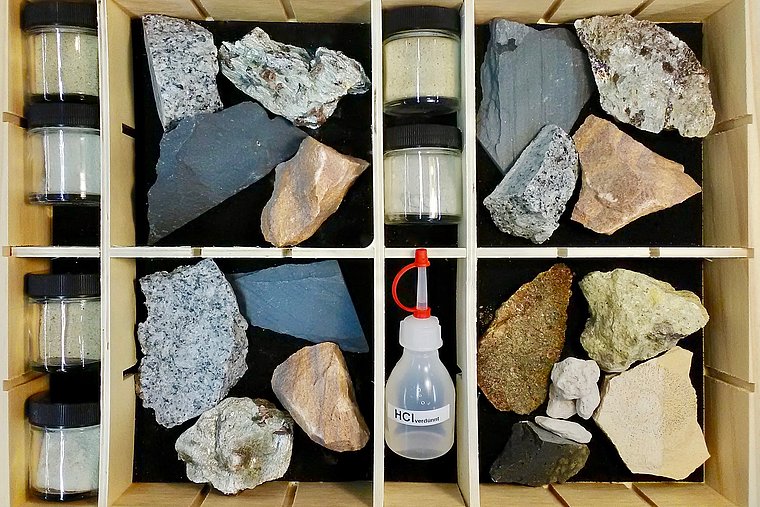
Content
Core area – Rock cycle for clayey-sandy starting material, 3-fold:
• Clay in the jar
• Sand in the jar
• Clay slate
• Garnet-mica schist
• Granite
• Sandstone
Extension, single (additional material for deepening):
• Limestone
• Basalt
• Pumice
• Eclogite
• Tuff
• Diluted HCl
Case dimensions: 36.5 cm x 28.0 cm x 7.0 cm
Weight: approx. 2.5 kg
Examples for Use in the Classroom:
Geography / Primary Education: Rock cycle, rocks as building materials, identifying and classifying different rock types, volcanism, weathering
Science and Technology: Rocks as building materials
Chemistry: Carbon and carbonates (lime cycle), silicate–carbonate cycle, weathering, dating of rocks
Physics: Density experiments and their relation to depth within the Earth
Biology: Formation of fossils, evolution
History: Rocks as building materials