

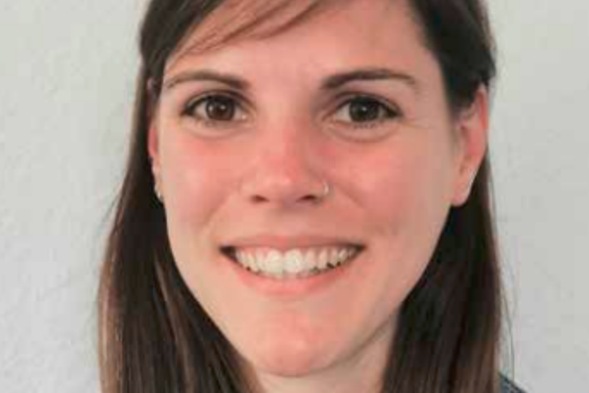

As several outstanding applications were received, the award committee decided to present the Beate Mocek Award to two recipients this year.
One award was presented to Leanne Schmitt (TH Georg Agricola University, Bochum) to support transmission electron microscopy (TEM) analyses at the University of Münster. The second award was presented to Lisa Kaatz (Freie Universität Berlin).
Lisa Kaatz plans a research visit to Lausanne to collaborate with colleagues on the numerical simulation of fluid–rock interaction processes.
In her doctoral project, “Geochemistry and Mineralogy of Volcano-Sedimentary Iron Ore Systems – from Sedimentation to Metamorphism,” Leanne Schmitt re-examines the genesis of Lahn-Dill-type iron ore deposits. Using state-of-the-art micro- to nanoscale analytical techniques, she aims to identify clear evidence for the origin of the metals and the mineralization processes responsible for this deposit type, while also establishing links to other submarine volcanogenic metal systems.
Lisa Kaatz's doctoral research, entitled “Coupling Deformation with Fluid Flow and Mineral Reactions Based on Natural Shear Zones – from Field Observations to Numerical Simulations,” focuses on understanding the interaction between deformation, fluids, and mineral reactions. At the beginning of her project, she collected samples from shear zone systems on the island of Holsnøy in western Norway. Her subsequent Fourier-transform infrared spectroscopy (FTIR) analyses of the water contents of selected nominally anhydrous minerals (NAMs) provided important insights into fluid–rock interaction and the resulting mineral reactions. Together with colleagues in Lausanne, she is now developing numerical models to simulate aqueous fluid diffusion and the resulting complex fluid–rock–deformation interactions, with the aim of improving our understanding of large-scale structural geological processes.