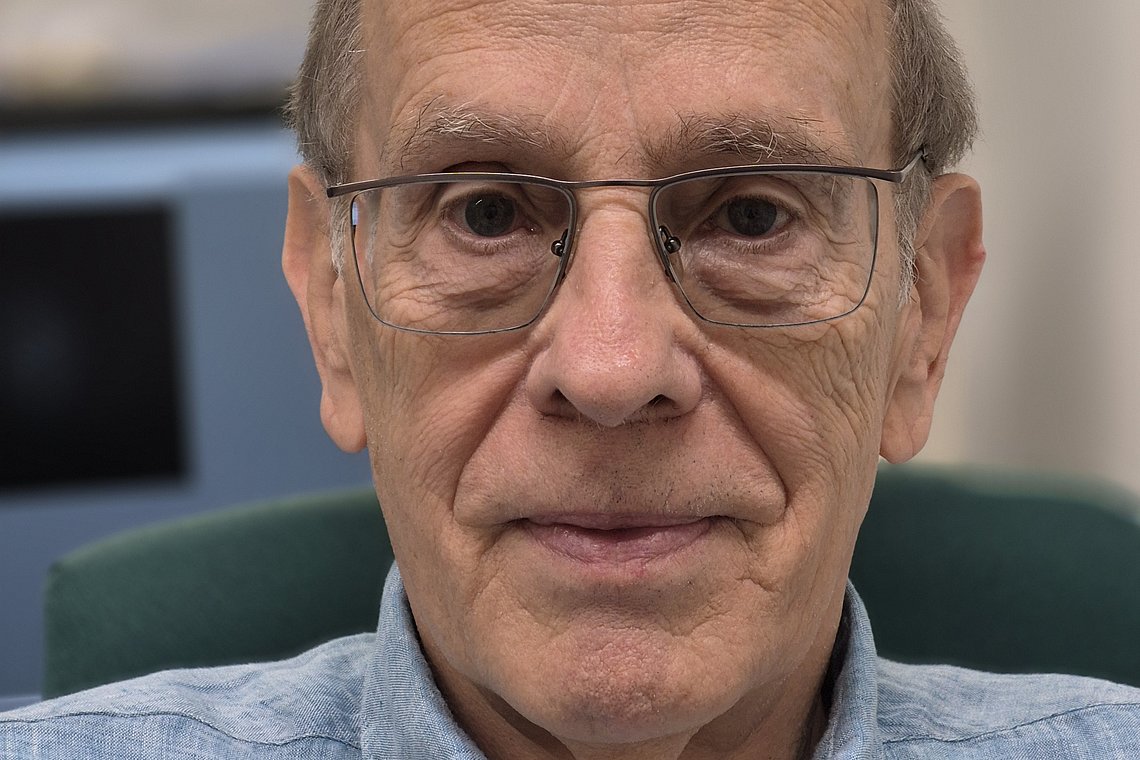
Richard Wirth is widely recognized as a specialist in transmission electron microscopy (TEM). His work, however, demonstrates that his scientific contributions extend far beyond methodological development and encompass a broad range of topics in mineralogy.
He received his diploma in mineralogy from the University of Würzburg in 1976 and completed his doctorate there in 1978 with a geochemical study of Early Palaeozoic basalts in northeastern Bavaria. After three years as a postdoctoral researcher at the Institute of Metal Physics at Saarland University with Prof. Gleiter, he held positions at the University of Cologne, as head of the Institute for New Materials (INM) in Saarbrücken, and at Ruhr University Bochum. In 1994, he joined GFZ Potsdam as head of the Transmission Electron Microscopy Laboratory, which he led until 2020. Since his retirement, he has continued his research there as a guest scientist.
Richard Wirth was the first to introduce focused ion beam (FIB) sample preparation for TEM to mineralogy and the geosciences. Together with his colleague Anja Schreiber, he established the necessary laboratory facilities and further developed the methodology. Particularly remarkable is the extent to which he has made this technique available to the scientific community: his publication record includes more than 1,000 co-authors worldwide. His two fundamental papers from 2004 in the European Journal of Mineralogy and 2009 in Chemical Geology have together received well over 1,200 citations.
His methodological achievements and exceptional commitment to scientific collaboration can easily overshadow his substantial contributions to specific fields of mineralogy and materials science. His research on diamonds, for example, has provided insights that would hardly have been possible without TEM. In particular, the identification of inclusions has yielded important evidence concerning diamond genesis. These inclusions include extremely rare compounds such as silicides, nitrides, carbonatitic melts, and various metal alloys. Together with his co-authors, Wirth demonstrated that diamonds are not only indicators of high-pressure and high-temperature conditions but may also form under other, volcanogenic conditions through deposition from the gas phase.
His research has also addressed zircon, the standard mineral used in radiometric dating. Investigations of nanoscale Pb inclusions have shown that TEM analyses not only provide a more robust basis for interpreting isotope geochemical data but can also offer opportunities to derive model ages for alteration and Pb mobilisation. These studies are particularly important for impact research, as demonstrated by investigations of the Vredefort Dome and lunar rocks from the Apollo 15 and Apollo 16 missions.
Richard Wirth has similarly demonstrated the importance of TEM for radiometric dating through studies of monazite and xenotime, in which metasomatic alteration and dissolution–precipitation processes play an important role, even at low temperatures. These investigations illustrate that TEM is indispensable for studying experimentally produced samples: transformation processes are often visible only at the nanoscale but can be crucial for interpreting isotopic data. At the atomic scale, Th and U may accumulate at defects and thereby contribute to discordant age data.
Another important contribution comes from his research on grain-boundary phenomena and reaction mechanisms. In several studies, he demonstrated the presence of an amorphous phase along grain boundaries that plays an important role in the mechanisms of dissolution–reprecipitation reactions. The significance of such observations extends far beyond metamorphic petrology and geochronology, with implications for processes such as weathering and the formation of clay minerals as well as the mechanical behaviour of rocks in fault zones.
While these topics belong to more classical areas of mineralogy, his work in organic geochemistry and bio–geo interactions is less conventional but highly innovative. His research has addressed biominerals in bones, carbonate skeletons, and fossil fungi, as well as the biogenic formation of Fe oxides and hydroxides, volcanic glass as a substrate for microbial life, and novel disordered Ca-bearing phases in coccolithophore algae.
The international recognition of Richard Wirth’s research is reflected not only in the high citation rates of his publications but also in numerous distinctions. He was elected Fellow of the Mineralogical Society of America in 2009 and Fellow of the Geological Society of America in 2010. He was Visiting Professor at the University of Vienna, Austria, in 2010/2011 and held the W. F. James Chair in Science at St. Francis Xavier University in Antigonish, Nova Scotia, Canada, in 2005. He received GFZ Research Awards in 2003 and 2005, served as Distinguished Lecturer of the Mineralogical Society of America in 2013/2014, and received the Hawley Medal of the Mineralogical Association of Canada in 2014.
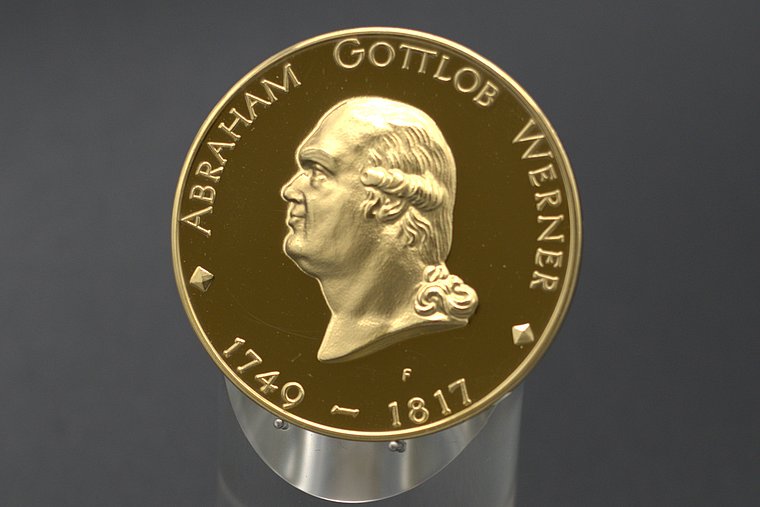
In recognition of his innovative research and his commitment to the international scientific community, the German Mineralogical Society awards Richard Wirth the Abraham Gottlob Werner Medal.
Gerhard Franz · Berlin