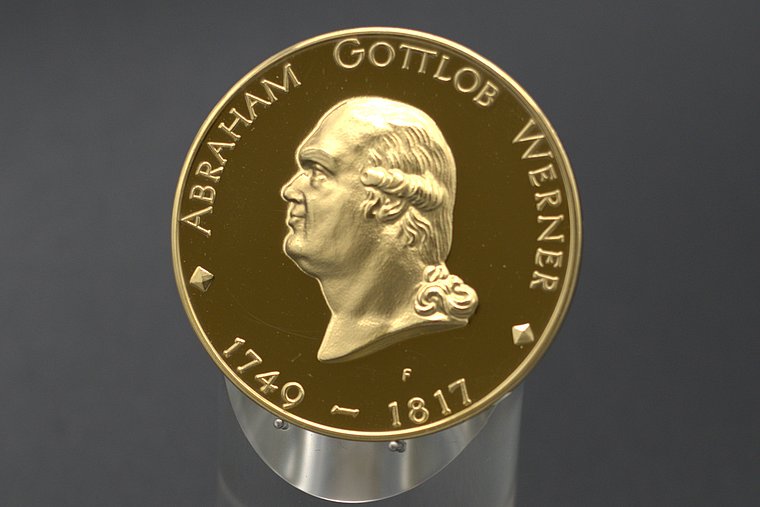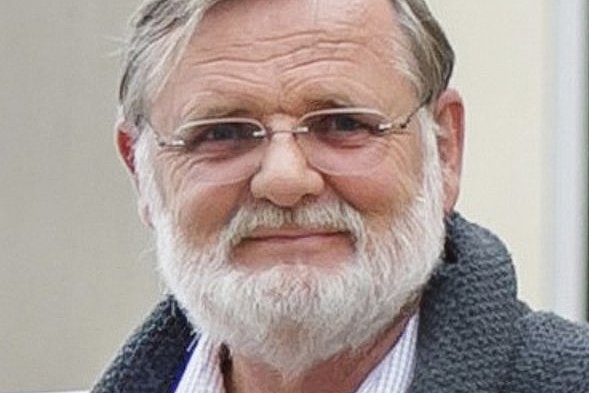
The Abraham Gottlob Werner Silver Medal of the German Mineralogical Society honors distinguished scientists for outstanding scientific achievements. The 2023 recipient is Dr. Thomas Oberthür.
Thomas Oberthür began studying Geology and Mineralogy at the University of Cologne in 1970 and graduated as a Diplom-Mineraloge in 1978. He subsequently worked as a Research Officer at the Chamber of Mines of South Africa until 1982, conducting both underground and laboratory investigations. Mineralogical, geochemical, and genetic studies of the Witwatersrand gold deposits formed the basis of his doctoral dissertation at the University of Cologne, completed in 1983.
In 1988, Thomas Oberthür joined the Federal Institute for Geosciences and Natural Resources (BGR) in Hanover. From 1989 until his retirement in 2014, he headed the Department of Ore Deposits and Provenance Studies of Mineral Resources. A major focus of his work was the mineralogical and geochemical investigation of African gold deposits in Ghana, Burkina Faso, Tanzania, Zimbabwe, and Morocco as part of the technical cooperation project "Metallogenesis of Gold in Africa." Numerous highly cited publications testify to the exceptional quality and international impact of his research on gold deposits.
Throughout his career, he also played a leading role in advancing mineralogical and geochemical methods for investigating ore deposits, particularly platinum-group element deposits. From 1995 onward, the mineralogy and geochemistry of platinum-group minerals became one of his principal research interests. His work focused especially on the development of high-spatial-resolution analytical methods and their application to understanding the genesis of primary platinum-group element deposits in southern Africa, particularly in Zimbabwe and South Africa. Of particular significance were his investigations into the comprehensive characterization and beneficiation of oxidized platinum ores. These studies were complemented by research on platinum-group minerals from heavy mineral placers in Zimbabwe, South Africa, the Philippines, and Germany. His research consistently combined fundamental scientific questions with practical applications relevant to the mining industry.
A special recognition of his long-standing contributions to platinum-group mineral research was the naming of the mineral oberthürite [Rh₃(Ni,Fe)₃₂S₃₂] in his honor by the International Mineralogical Association's Commission on New Minerals, Nomenclature and Classification (IMA 2017-072).
Thomas Oberthür's scientific interests extended far beyond gold and platinum deposits. He initiated and contributed to numerous ore deposit research projects at the BGR, including the development of the scientifically and politically important "analytical fingerprint" for niobium-tantalum minerals (coltan). This work was supported by extensive BGR field campaigns across Africa, including the Democratic Republic of the Congo and neighboring countries, Ethiopia, Mozambique, and Namibia.
His third major field of research focused on high-technology metals such as indium, germanium, and antimony. Drawing on his experience from gold and platinum research in Africa, he also played a key role in introducing automated mineralogy techniques at the BGR in Hanover while maintaining close collaborations with international research groups.
Thomas Oberthür combined classical reflected-light microscopy with state-of-the-art microanalytical techniques, including electron probe microanalysis (EPMA), laser ablation ICP-MS, Mineral Liberation Analysis (MLA), and secondary ion mass spectrometry (SIMS), integrating these methods into his extensive publication record. Through international development projects and BGR research activities, he mentored numerous German and international students and trainees, particularly from Africa, many of whom now occupy leading positions in ore deposit research and the global minerals industry.
He also made substantial contributions to the German Mineralogical Society, including serving for many years as Chair of the Working Group on Ore Deposit Research until his retirement in 2014. Through his tireless fieldwork, particularly in southern Africa, his broad scientific expertise, his extensive international network spanning academia and industry, and his dedication to mentoring students and visiting scientists from around the world, he has influenced an entire generation of ore deposit geologists.
His scientific output comprises more than 80 peer-reviewed publications in international journals and books, which have accumulated more than 2,600 citations in Scopus. His outstanding research has established him as one of the world's leading specialists in the mineralogy and geochemistry of ore-forming processes, particularly those involving gold and platinum-group elements.
By awarding the Abraham Gottlob Werner Silver Medal, the German Mineralogical Society honors an outstanding geoscientist who has not only made major application-oriented contributions to securing industrial supplies of critical raw materials but has also shared his knowledge with exceptional enthusiasm through teaching and public engagement.
—
Torsten Graupner ∙ Hanover, Peter Buchholz ∙ Berlin & Horst Marschall ∙ Frankfurt/Main