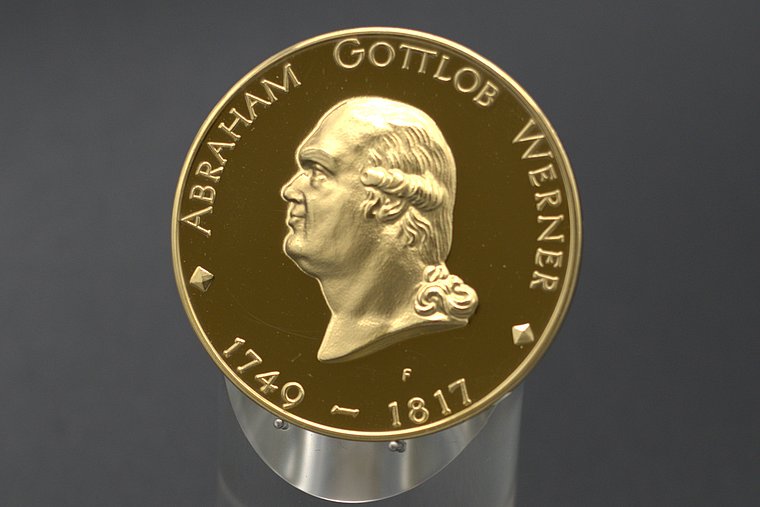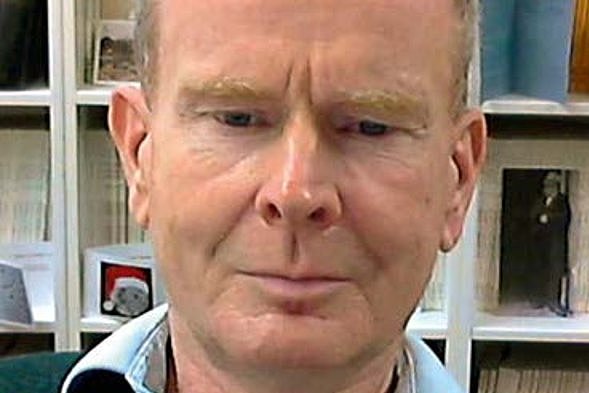
The Abraham Gottlob Werner Silver Medal is the highest scientific distinction awarded by the German Mineralogical Society (DMG). It recognizes outstanding scientific achievements by leading researchers. In 2022, the medal was awarded to Hans Keppler, Professor of Experimental Geophysics at the Bavarian Research Institute of Experimental Geochemistry and Geophysics (Bayerisches Geoinstitut), University of Bayreuth.
Hans Keppler completed parallel degree programs in Mineralogy and Chemistry at the University of Karlsruhe, graduating in 1985 and 1988, respectively. He also earned his doctorate there in 1988. Following two years as a postdoctoral researcher at the California Institute of Technology, he joined the newly established Bayerisches Geoinstitut in Bayreuth in 1990 as a researcher and Heisenberg Fellow. In 2000, Hans Keppler was appointed Professor of Physical-Chemical Mineralogy at the University of Tübingen. One year later, he received the Gottfried Wilhelm Leibniz Prize, the highest distinction awarded by the German Research Foundation (DFG). In 2004, he returned to the Bayerisches Geoinstitut as Professor of Experimental Geophysics, where he established an extensive international network of collaborations built around the institute's world-renowned experimental and analytical facilities. Since 2008, he has been a member of the German National Academy of Sciences Leopoldina. He received the Bowen Award of the American Geophysical Union in 2010 and became an AGU Fellow the same year. Since 2012, he has also been a Fellow of both the Geochemical Society and the European Association of Geochemistry, and in 2019 he was awarded the Federal Cross of Merit of Germany.
Hans Keppler is internationally recognized as one of the world's leading scientists in the experimental simulation of geological processes, spanning near-surface volcanic systems to the Earth's deep interior under extreme pressure and temperature conditions. His research focuses on the physical and chemical properties of volatile components, silicate melts, and mantle minerals. He has published an exceptional body of work in leading international journals such as Nature, Science, and Earth and Planetary Science Letters. In addition, he has authored several book chapters and edited the Reviews in Mineralogy volume Water in Nominally Anhydrous Minerals. His publications are widely admired for their originality, clarity, and scientific depth.
Hans Keppler is responsible for a series of scientific breakthroughs that have fundamentally advanced our understanding of Earth's interior. These achievements were made possible through the development of innovative experimental and analytical techniques, including in situ infrared and Raman spectroscopic measurements of fluids, silicate melts, and minerals under extreme pressure and temperature conditions, as well as experimental investigations of the solubility of H₂O, carbon, and nitrogen in mantle minerals. His pioneering work has made lasting contributions to mineralogy, geochemistry, and volcanology and has significantly improved our understanding of dynamic processes in the Earth's crust, subduction zones, the upper mantle, and the mantle transition zone.
Among his many landmark achievements, Hans Keppler and his collaborators elucidated the mechanism by which water dissolves in silicate melts through direct infrared spectroscopic measurements performed on samples in diamond anvil cells at temperatures approaching 1,000 °C. He also observed in situ the closure of the miscibility gap between aqueous fluids and silicate melts under pressure-temperature conditions corresponding to the source regions of subduction zone magmas. These studies provided key insights into the influence of dissolved water on melt viscosity and into the mechanisms of metasomatic processes within mantle wedges.
In another technically demanding experimental study, Hans Keppler demonstrated that carbon dissolves in mantle minerals only at concentrations well below the ppm level and therefore most likely exists as a separate carbonate phase. This finding implies that the generation of large igneous provinces from carbonate-rich mantle domains could release enormous quantities of CO₂ over relatively short geological timescales, providing a plausible mechanism for several global mass extinction events associated with flood basalt volcanism.
Spectacular in situ measurements of the optical absorption spectra of iron-bearing mantle minerals further revealed that these minerals remain remarkably transparent even at pressures approaching 1 Mbar, demonstrating that radiative heat transfer plays an important role in the lower mantle. In contrast, the effect of the iron spin transition on thermal conductivity proved to be comparatively minor. These results overturned several long-standing assumptions in geophysics.
Throughout his scientific career, Hans Keppler has successfully supervised numerous postdoctoral researchers and doctoral students within externally funded research projects. Many of his former students have gone on to establish distinguished international scientific careers. His influence as a scientist in experimental high-pressure and high-temperature research, together with the global significance of the laboratories he has built at the Bayerisches Geoinstitut, is truly unique.
For these outstanding scientific achievements, the German Mineralogical Society awards Hans Keppler the Abraham Gottlob Werner Silver Medal.
—
François Holtz ∙ Hannover, Marcus Nowak ∙ Tübingen & Alan Woodland ∙ Frankfurt