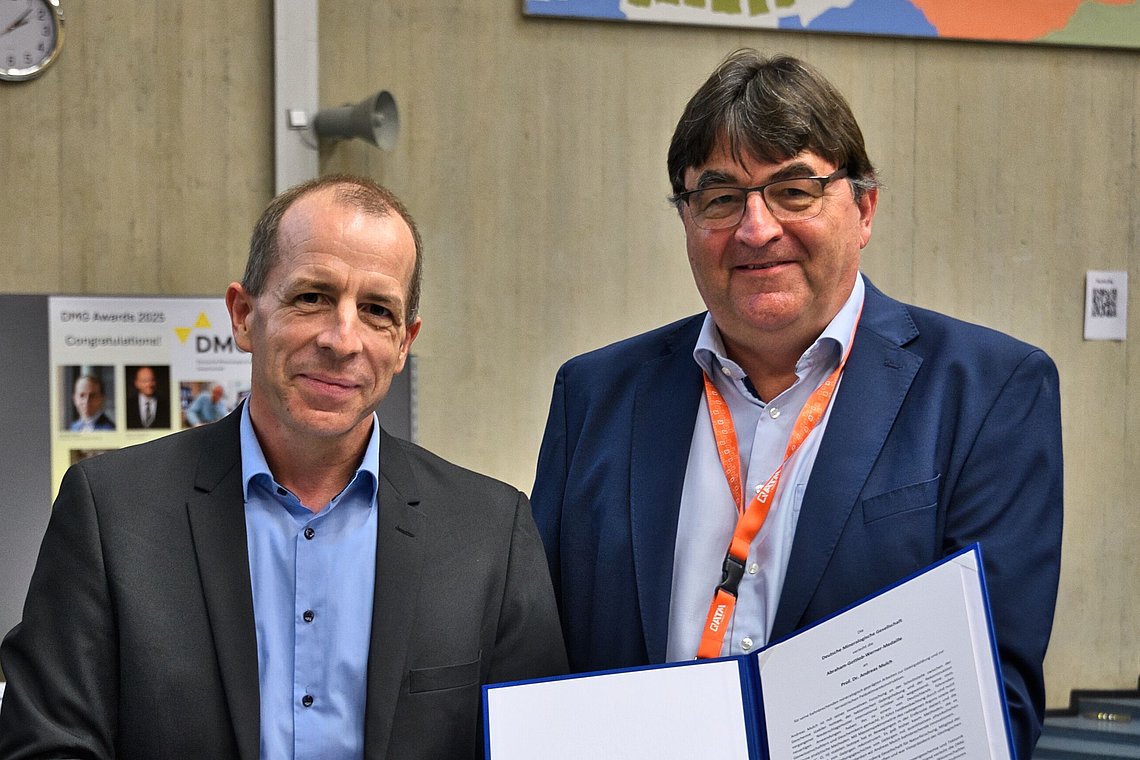
Andreas Mulch's innovative research lies at the interface of stable isotope geochemistry, tectonic mountain uplift, and the reconstruction of past precipitation patterns. His consistently novel applications of isotope geochemistry have established him as one of Germany's leading geoscientists and geochemists.
Andreas Mulch studied Geology at the University of Giessen and earned his PhD in Mineralogy and Geochemistry at the University of Lausanne. He subsequently held postdoctoral positions in the United States at the University of Minnesota and Stanford University before being appointed to a W2 Professorship at Leibniz University Hannover from 2007 to 2010. Since 2010, he has been Professor (W3) of Paleoclimate and the Dynamics of Paleoenvironmental Processes at Goethe University Frankfurt and serves as Vice Director of the Senckenberg Society for Nature Research. Andreas Mulch is also an elected Fellow of the Geological Society of America.
His research combines detailed field observations with state-of-the-art analytical techniques. Using radiogenic argon geochronology together with stable isotope analyses of carbon, oxygen, and hydrogen, he has dated crustal deformation and reconstructed the uplift history of mountain belts. These questions are of central importance in Earth and climate sciences, as long-term climate regulation through rock weathering and atmospheric CO₂ removal is closely linked to erosion, precipitation, and the simultaneous uplift of mountain ranges.
Until recently, however, few methods existed that allowed the quantitative reconstruction of mountain uplift histories. Andreas Mulch has made several groundbreaking methodological advances that have transformed this field.
Four particularly important developments deserve special mention:
Determining paleoelevation during mountain building: During his doctoral research, Mulch determined the K–Ar ages of shear zones in the North American Cordillera and analyzed the hydrogen isotope composition preserved within them. Because hydrogen isotope ratios vary systematically with elevation, he demonstrated that these shear zones formed within a mountain range approximately 4,000 m high. This revealed that the Cordillera had already reached an elevation of around 4 km about 49 million years ago, providing one of the first quantitative methods for reconstructing paleotopography.
Reconstructing the uplift of the Andes: Among Andreas Mulch's most significant achievements is his detailed reconstruction of Andean uplift. By combining paleoelevation estimates with stable isotope analyses of paleosols, volcanic clays, and authigenic carbonates, he showed that uplift began around 25 million years ago, reaching elevations of approximately 2 km, before accelerating dramatically between 10 and 5 million years ago to produce elevations of around 4 km. Since then, the Altiplano and the high Andes have remained established. These findings were linked to mantle dynamics, including subduction processes and subsequent delamination of the lithospheric mantle.
Reconstructing vegetation and climate in Central Asia during the Middle Eocene Climatic Optimum: Using a comprehensive suite of modern geochemical methods—including total organic carbon (TOC), organic δ¹³C, n-alkane δ¹³C and δ²H, X-ray diffraction mineralogy, and δ¹⁸O and Δ⁴⁷ measurements of pedogenic carbonates—Mulch and his colleagues reconstructed vegetation and hydrological conditions during the early Eocene greenhouse climate (57–44 million years ago). Their results demonstrated that precipitation temporarily doubled and that steppe landscapes were replaced by forested ecosystems. They attributed these changes to the massive release of greenhouse gases during the Paleocene–Eocene Thermal Maximum. These ancient "proto-monsoon" systems provide valuable analogues for understanding future climate change by illustrating how warming can profoundly alter precipitation patterns and ecosystems.
Reconstructing terrestrial climate using clumped isotope thermometry: More recently, Andreas Mulch and his collaborators applied clumped isotope (Δ⁴⁷) thermometry to pedogenic carbonates from the Rocky Mountains to reconstruct terrestrial climate during the Miocene Climatic Optimum (17–15 million years ago). Although this warming interval is well documented in marine sediments, corresponding terrestrial records had remained scarce. Their work revealed that warming in the Rocky Mountains was considerably less pronounced than in the oceans, indicating a partial decoupling between continental and marine climate systems.
These four examples clearly demonstrate Andreas Mulch's ability to develop innovative analytical methods and apply them to previously unexplored scientific questions. His work is founded on a profound understanding of the formation conditions of datable minerals and isotope fractionation between minerals and fluids. At the same time, it highlights his exceptional ability to integrate tectonics, geochemistry, mineralogy, and paleoclimate research in order to address some of the most important questions in the Earth sciences.
Beyond his scientific achievements, Andreas Mulch has made outstanding contributions to the geoscience community through his service as Vice Director of the Senckenberg Society for Nature Research, as a member of the German Research Foundation (DFG) Senate Commission on Earth System Sciences, and as former Vice President of the Geological Association (Geologische Vereinigung, GV).
In recognition of his pioneering research at the interface of isotope geochemistry and tectonics, as well as his outstanding service to the German geoscience community, the German Mineralogical Society awards Andreas Mulch the Abraham Gottlob Werner Medal.
—
Friedhelm von Blanckenburg · Berlin