

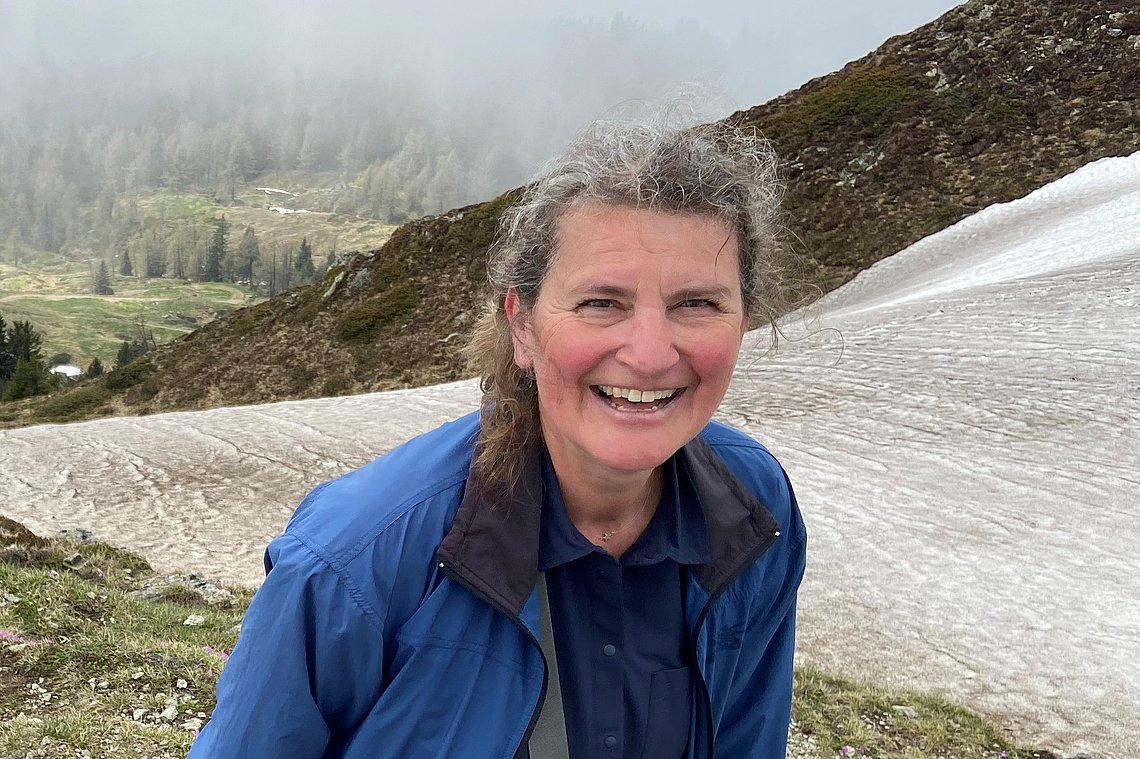
1. How did you come to your field, and what motivated you to specialize in it?
My path into my current field was not straightforward—I took many detours, and I am extremely glad that I did. I initially studied geology and paleontology up to the intermediate diploma at the University of Würzburg. I very much appreciated the broad scope of the program, ranging from petrology and tectonics to botany, as well as courses in zoology, chemistry, and physics, and I still benefit from this wide-ranging education today. However, I already realized back then that I preferred laboratory work over fieldwork, which led me to specialize in mineralogy, geochemistry, and economic geology at the institute of Martin Okrusch.
I greatly enjoyed working with a variety of analytical techniques, and since I was particularly interested in X-ray diffraction, it was a natural step to move more toward crystallography. In my diploma thesis with Ekkehart Tillmanns, I worked on the characterization and structural analysis of a natural mineral from the Eifel region, orschallite. During my PhD with Reinhard Fischer at the University of Mainz, my focus shifted to the synthesis and structural characterization of synthetic zeolites. My co-supervisor, Klaus Unger, was a professor of inorganic chemistry, which further sparked my interest in synthetic functional materials.
Over time, I gradually moved away from core geoscience topics and focused increasingly on characterization methods such as diffraction techniques, electron microscopy, and spectroscopic methods. For more than 25 years, I have been working as a scientist at the Max Planck Institute for Coal Research, and I am also an adjunct professor at the University of Duisburg-Essen. At the Max Planck Institute, I lead the research group “Powder Diffraction and Surface Spectroscopy,” where my team investigates structure–property relationships in catalysts, particularly in the context of energy-related applications.
Our work spans carbon materials for electrodes, perovskites for electrochemical water splitting to produce hydrogen, zeolites for gas separation and storage, and metals and alloys for ammonia synthesis. I still use many of the methods I learned during my studies. A central focus is the implementation of in situ techniques that allow us to analyze functional materials under real reaction conditions. Today, I feel that the circle has come full circle: modern mineralogical research incorporates advanced techniques and increasingly includes synthetic materials, creating strong connections to colleagues in mineralogy and crystallography working on natural systems.
2. What are the biggest challenges in your field, and how do you deal with them?
One major challenge in my case was starting out as a mineralogist in a chemical research institute 25 years ago, where I was often associated with field-based rock studies. It took time to establish that my expertise in crystallography extends far beyond structure determination and includes understanding structure–property relationships.
I clearly benefit from my background in crystal chemistry, geochemistry, and the wide range of analytical techniques I acquired during and after my studies in mineralogy and crystallography. Through years of collaboration with colleagues in chemistry, I have come to realize that the knowledge taught in mineralogy programs is not covered by other disciplines such as chemistry or physics. If this mineralogical education continues to decline, essential foundational knowledge will be lost.
I already observe this in crystallography, where many academic chairs have been closed. The specialized knowledge they provided cannot be fully integrated into other curricula, such as chemistry programs, due to time constraints and a lack of teaching staff. Workshops alone cannot compensate for this loss.
3. What advice would you give to young people interested in your field?
My PhD students sometimes feel that they have to learn too many characterization methods. However, this broad analytical skill set, combined with engagement in current research topics and innovative materials, is key to a successful career today. I strongly encourage young researchers to build a broad foundation, look beyond their immediate field, and remain curious—even when it requires perseverance.
My research group is highly diverse, including geoscientists, mineralogists, materials scientists, chemists, physicists, and metallurgists. I believe that this kind of open, interdisciplinary collaboration is essential for addressing future challenges.
4. What is your favorite mineral?
This is certainly the most difficult question, and I thought about it for a long time. My choice is Opal—an amorphous mineral with a fascinating play of colors that changes continuously depending on the angle of light, giving it a mysterious appearance.
Opal is also an excellent example of how nature can serve as a prototype for synthetic analogues with interesting properties. Opals belong to the class of photonic crystals, which are being studied for applications in photovoltaics and semiconductor electronics.
