

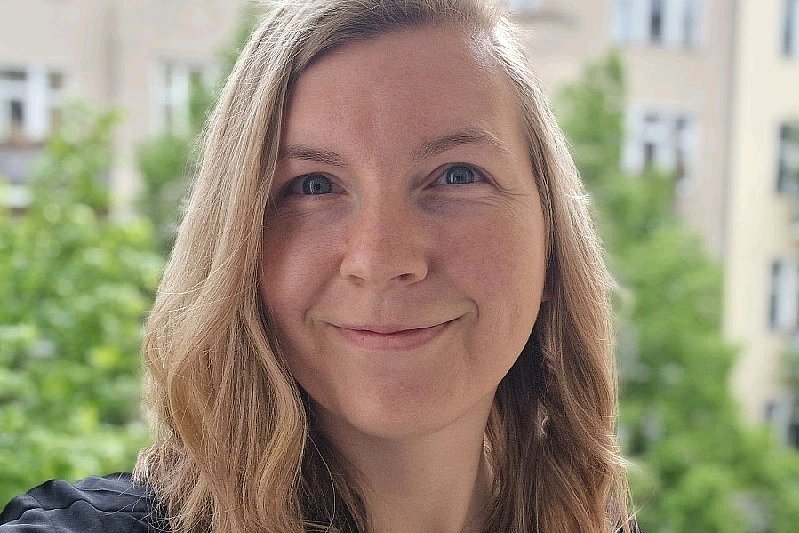
This time, we invited Kerstin Hauke to share insights into her career path. Kerstin has been working for several years at the Forschungsgemeinschaft Feuerfest e. V., based in the “Kannenbäckerstadt” Höhr-Grenzhausen in the Westerwald region.
1. How did you come to your field, and what motivated you to specialize in it?
My entry into the geosciences was rather accidental, but I soon discovered my passion for mineralogy. I was particularly fascinated by “Applied Mineralogy,” as it clearly demonstrates how essential mineralogical expertise is for producing many everyday materials. At the University of Bonn, great emphasis was placed on learning and applying a wide range of analytical methods—experience that I still benefit from today. My studies took me to the Pyrenees, Greek islands, and across Tunisia—unforgettable experiences, both academically and personally. The question of how to apply theoretical knowledge in practice continues to drive me.
In my bachelor’s thesis at the Verein Deutscher Zementwerke in Düsseldorf, I investigated whether burnt lime in cement could be replaced by clays to reduce CO₂ emissions. During my master’s and doctoral research with Thorsten Geisler-Wierwille, I developed high-temperature Raman imaging as a method to analyze the firing processes of silicate ceramics up to 1,200 °C in situ. This technique enables the simultaneous spatial, temporal, and temperature-resolved investigation of mineral reactions at the micrometer scale—something that sets it apart from conventional analytical methods.
After completing my PhD, I left academia and moved into industry-related research. Family considerations and the desire for more practical work played a key role in this decision. Today, I work at the Forschungsgemeinschaft Feuerfest e. V., where I focus on optimizing high-temperature Raman imaging for the refractory industry and on increasing the use of secondary raw materials in refractory products. This allows me to combine my passion for innovative analytical methods with sustainable materials development.
2. What are the biggest challenges in your field, and how do you address them?
The refractory industry is undergoing profound transformations, both technically and culturally. As an energy-intensive sector reliant on high-temperature processes, it faces the challenge of achieving climate-neutral production. At the same time, its importance for Europe’s industrial future is immense: without refractory materials, there would be no steel, glass, or cement—and thus no cars, buildings, or smartphones.
Key challenges include developing innovative refractory materials that support more energy-efficient and climate-neutral production processes, improving durability, and replacing primary with secondary raw materials. The Forschungsgemeinschaft Feuerfest e. V. contributes by developing advanced analytical methods to study high-temperature behavior in situ, enabling better material design.
Another major issue is the shortage of skilled professionals. Increasing the participation of women is an important step. Currently, the proportion of women in the industry is estimated at only around 20% in Germany, and even lower in leadership positions. To address this, I co-founded the initiative Women@Refractories together with colleagues, aiming to connect women in the field, highlight the benefits of diversity, and promote the refractory industry as an attractive career path.
Visibility is also a broader challenge—for both the refractory sector and disciplines such as mineralogy and crystallography. In a world where career perceptions are shaped by social media, it is our responsibility to actively communicate the opportunities in our field and inspire the next generation.
3. What advice would you give to young people interested in your field?
I would recommend building a solid and broad educational foundation. This allows for flexibility later on, especially if career goals are not yet clearly defined. Beyond technical expertise, social skills and professional networks are equally important. Early engagement through internships, student initiatives, or professional associations can open unexpected opportunities.
Exploring different areas through internships helps identify personal interests more clearly. If possible, spending time abroad—whether through study or internships—broadens both professional and personal perspectives. Often, experiences beyond formal coursework play a decisive role in shaping a career.
The refractory industry offers exciting opportunities to contribute to major global challenges, from climate neutrality to resource efficiency. A scientific background provides an excellent entry point, and internships with manufacturers or research institutes offer valuable practical insights. There are many pathways into this field.
4. What is your favorite mineral?
My favorite mineral is Andalusite (Al₂SiO₅), a fascinating aluminosilicate and one of three polymorphs, alongside kyanite and sillimanite. Despite having the same chemical composition, these minerals differ in crystal structure and properties. Andalusite is highly valued in refractory materials due to its excellent resistance to thermal shock.
A particularly interesting feature is its transformation at temperatures above 1,200 °C into mullite and silica (SiO₂), accompanied by a volume increase that compensates for shrinkage in ceramic materials. This helps maintain structural stability under extreme conditions.
However, andalusite cannot be synthesized artificially, as its formation requires specific pressure and temperature conditions, making it a limited natural resource. Current research therefore focuses on potential substitutes, such as recycling materials previously used in refractory applications—an approach that supports both sustainability and resource efficiency.
— Claudia Weidenthaler · Mülheim an der Ruhr