

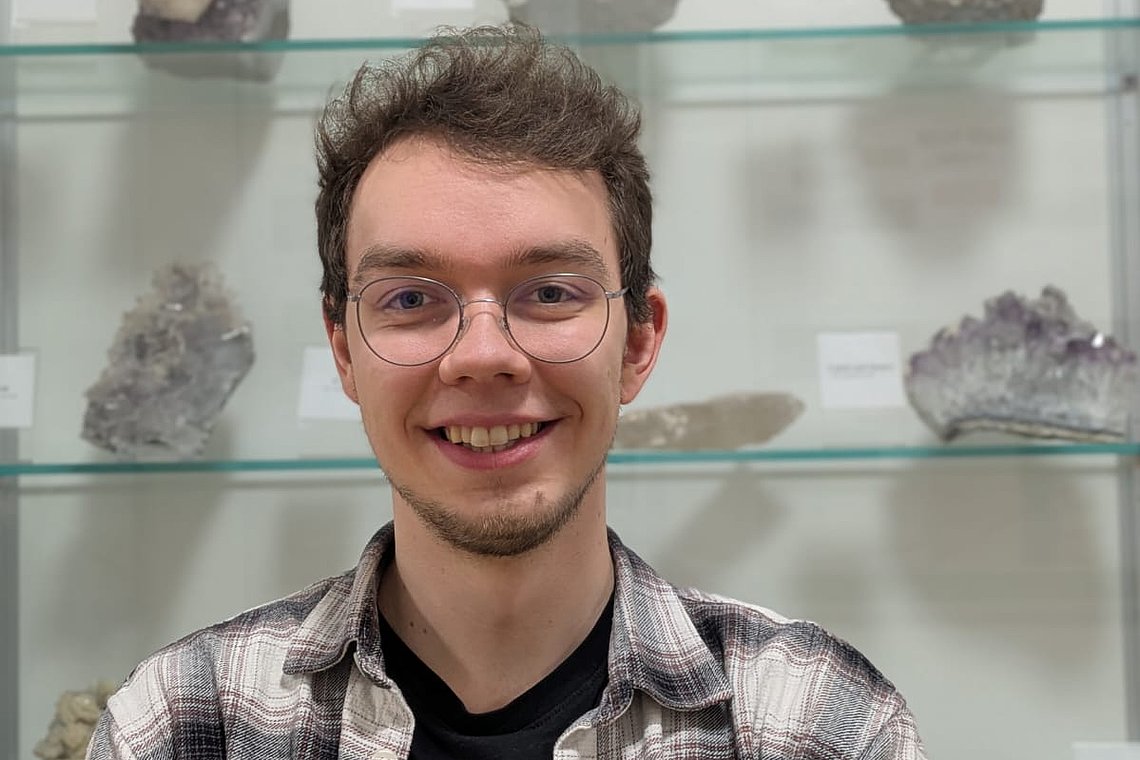
In this issue, Cornelius Gantz answers the editorial team’s questions. He is pursuing his PhD at the Martin Luther University Halle-Wittenberg in cooperation with ITEL – Deutsches Lithiuminstitut GmbH. As a technical mineralogist, he focuses on questions of resource efficiency, particularly through recycling processes and the utilization of by-products. His doctoral research investigates lithium recycling from lithium-ion batteries.
1. How did you come to your field, and what motivated you to specialize in it?
My academic path began quite typically with a degree in Applied Geosciences at Martin Luther University Halle-Wittenberg. When asked why they chose geosciences, many first-year students tend to give one of three answers:
“I collected rocks and minerals and wanted to understand the Earth as a system,”
“Dinosaurs!”,
or “There was no admission restriction, and I didn’t know what else to study after school.”
I belonged to the second category—I wanted to do “something with dinosaurs.”
During my bachelor’s studies, I became fascinated by the diversity of the geosciences. I was interested in almost everything—except anything involving “hydro” (apologies at this point). I found economic geology particularly exciting, which led me to write my bachelor’s thesis under Gregor Borg on the final phase of the project investigating the origin of the gold of the Nebra Sky Disc. Using transmitted and reflected light microscopy, I reconstructed an ore formation sequence for a historical mining shaft near the Carn Marth pluton in Cornwall, England.
In my master’s studies, I discovered applied mineralogy. At Halle, this field has traditionally been very strong, formerly led by Herbert Pöllmann and now by Christiane Stephan-Scherb. My master’s thesis, again supervised by Gregor Borg, focused on economic geology in cooperation with industry. I investigated the formation and potential utilization of technical heavy mineral placers along a gravel processing plant. This highly analytical, laboratory-based work showed me how geosciences can contribute to a more sustainable society—especially in terms of efficient resource use.
Even before starting my master’s thesis, I knew I wanted to pursue a PhD and stay in academia. I had originally planned to move to a different university, but before actively searching, I learned that the newly founded German Lithium Institute was looking for a doctoral candidate. The topic—lithium recycling from lithium-ion battery recycling slag—perfectly matched my interests, combining applied mineralogy, economic geology, and sustainability. I began my PhD in autumn 2022 under the supervision of Stefan Stöber.
2. What are the biggest challenges in your field, and how do you deal with them?
In the context of the ongoing energy transition, lithium has likely become one of the most prominent metals in public discourse—despite, or perhaps because of, its frequent misclassification as a rare earth element. We know that lithium is essential for batteries used in electric vehicles and for decentralized energy storage systems supporting renewable energy grids. When these batteries reach the end of their life cycle, their metals should be recycled to ensure resource efficiency.
Lithium remains a key component of high-energy-density cathode materials, even as other elements such as manganese, cobalt, nickel, aluminum, iron, and phosphorus are substituted. However, this constant evolution in cathode chemistry creates a major challenge: recycling processes must handle highly variable and complex material streams. Many hydrometallurgical approaches struggle with this variability. Pyrometallurgical processes are more robust and are already in use, but their economic viability often depends on the nickel and cobalt content, especially since lithium recovery is currently limited.
Beyond resource efficiency, there are also geopolitical considerations. Europe is heavily dependent on China for lithium chemicals used in battery production. Long-term supply contracts between Chinese refineries and mining companies outside China reinforce this dependency. This has been recognized at the EU level, leading to regulations such as the EU Battery Regulation and the Critical Raw Materials Act, which set recycling targets and quotas for recycled materials in new batteries.
3. What advice would you give to young people interested in your field?
As an early-career scientist, I am still at the beginning of my own path, but I can share a few decisions that proved beneficial.
Since my bachelor’s thesis, I have always been part of a research group at my university. This offers many advantages. Especially during undergraduate studies, it is valuable to engage in group activities such as excursions or social events, which provide opportunities to connect with more experienced researchers outside formal teaching settings. Fellow students in these groups often become future colleagues encountered again during PhDs, conferences, or professional careers.
If you are reading this, you are likely already involved in a geoscientific society or considering joining one. If you are interested in mineralogy—particularly applied mineralogy—the DMG is the ideal professional society. I have been a member since 2022 and regularly attend section meetings and annual conferences. The DMG has always been very supportive, and it provides valuable networking opportunities with people you may later collaborate with or apply to for positions.
4. What is your favorite mineral?
That is a difficult question. From a purely aesthetic perspective, I find garnet fascinating, with its wide range of colors from deep red to green and its well-formed crystals typical of the cubic crystal system.
However, I would also like to highlight the rather lesser-known but widely used beta-eucryptite (LiAlSiO₄). This inconspicuous mineral has several remarkable properties: it shares its space group with high quartz and forms a complete solid solution series with it. It is also used in glass-ceramic cooktops because of its slightly negative thermal expansion, which protects against thermal shock and increases durability.
I became interested in β-eucryptite during my PhD because it is chemically similar to spodumene (LiAlSi₂O₆), the most important lithium ore mineral. Due to its lower SiO₂ content, β-eucryptite contains proportionally more lithium, making it a highly interesting secondary lithium resource.