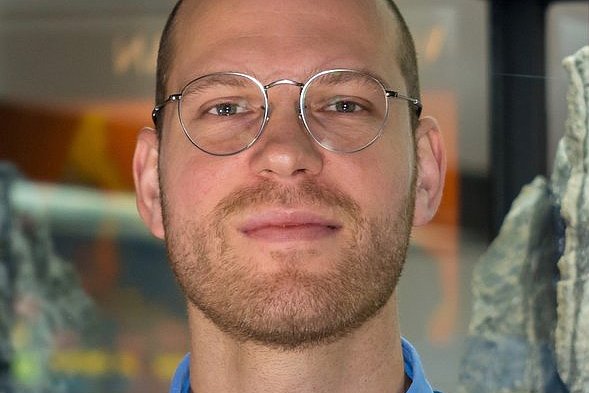
The German Mineralogical Society awards the Victor Moritz Goldschmidt Prize to outstanding early-career scientists in recognition of particularly significant research carried out during the preceding five years. In 2020, the prize was awarded to Dr. Mathias Burisch-Hassel, whose work is distinguished by exceptional creativity and consistently outstanding intellectual quality. After completing vocational training as a chef, he decided to study Mineralogy at the University of Freiburg before moving to the University of Tübingen in 2013 to pursue his doctoral studies. There, he entered the field of ore deposit geology and completed an outstanding dissertation on the genesis of vein-type silver–cobalt–nickel–arsenic deposits in the Odenwald, with a particular focus on understanding these mineralizations from a systems perspective. Among his most important findings was the demonstration that five-element vein deposits worldwide form through reduction by methane and that the interaction of aqueous fluids with gneisses, granites, and sandstones generates ore-forming fluids. This was the first quantitative demonstration of these processes across a range of salinities, grain sizes, temperatures, and rock types, providing fundamental insights into many ore-forming systems.
Immediately after completing his PhD in 2016, Dr. Burisch-Hassel joined TU Bergakademie Freiberg, where he currently serves as Research Associate at the Chair of Ore Deposit Geology and Petrology. Shortly after his arrival, he successfully secured funding for an EU-supported junior research group. This Mineral Systems Analysis group comprises four doctoral researchers, supported by a large number of MSc and BSc students. Under Dr. Burisch-Hassel's leadership, the group is developing a new, scientifically robust model for the genesis of magmatic-hydrothermal ore deposits in the Erzgebirge. Within only two years, the project has already produced numerous surprising results. Key achievements include the identification of distinct groups of skarn deposits in the Erzgebirge that differ systematically in age and composition, as well as the clear classification of the rich silver mineralization of the Freiberg district as part of an epithermal magmatic-hydrothermal system. The relevance of these findings for mineral exploration is underscored by close and trusted collaborations with all major exploration companies operating in the region. A major reason for this success is that, despite his early career stage, Mathias Burisch-Hassel possesses the broad range of expertise required to excel in mineralogy, petrology, and ore deposit geology. He is therefore a highly deserving recipient of the Victor Moritz Goldschmidt Prize of the German Mineralogical Society and a scientist with exceptional future potential.
Gregor Markl ∙ University of Tübingen & Jens Gutzmer ∙ HIF Freiberg