Dear members and friends of the DMG,
"Attractive working conditions in academia are an essential prerequisite for attracting and retaining talented young people for science and research in the national and international competition for the best minds," states the explanatory memorandum for the newly proposed revision of the WissZeitVG, the Academic Fixed-Term Contract Act; and further: "Scientists need framework conditions under which they can develop their potential.“So far, all those involved and affected are probably in agreement. There is also agreement that the conditions at German universities, under which scientists try to develop their potential in the period after their doctorates, are not optimal for them or for the institutes. Lack of prospects and inadequate planning are criticized. One might therefore think that the goal of improving the situation is clearly in sight and that all that is needed is to choose the right means to offer the best minds the ideal framework conditions. However, there are also different ideas about what the ideal university in Germany should look like – for example, the humanities differ from the natural sciences, the goals pursued by the Federal Ministry of Education and Research (BMBF) differ from what the ministries of the federal states want to implement and finance, which in turn differ from the universities and their different status groups on the ground. Above all, there is European labor law, which actually sets clear limits for fixed-term employment contracts, but which are stretched quite a bit by the universities by defining very long qualification periods for academics. The situation for students and doctoral candidates at German universities is very good – at least in the geosciences.
There is a high student-to-faculty ratio, a lot of contact with instructors, and fundamental and intensive training in the field, in the laboratory, and in the lecture hall, including well-equipped libraries and digital infrastructure. Fixed-term employment contracts during the doctoral phase are generally accepted, and no one demands permanent employment for doctoral candidates, as this is undoubtedly a genuine qualification phase in preparation for a career in science, research or teaching (whether at a university or, for example, a state or private research institution, a government agency, an industrial company or an educational institution). In addition, it is clear that after the doctorate, there is usually a change of employer and remaining at the same university is only desired in exceptional cases. However, the aforementioned lack of predictability in the postdoctoral phase is critical. Here, the classic career path in Germany provides for the habilitation and preparation for a suitable, vacant professorship. Overall, it may help to realize that, with the number of university staff remaining roughly the same, the purely statistical chance of a professorship results from the trivial fact that each professorship that becomes vacant can only be filled by a single person – of all the students, doctoral candidates, and staff members that a professor has supervised, taught, or mentored over a career of 25 or more years, only one person can succeed them!
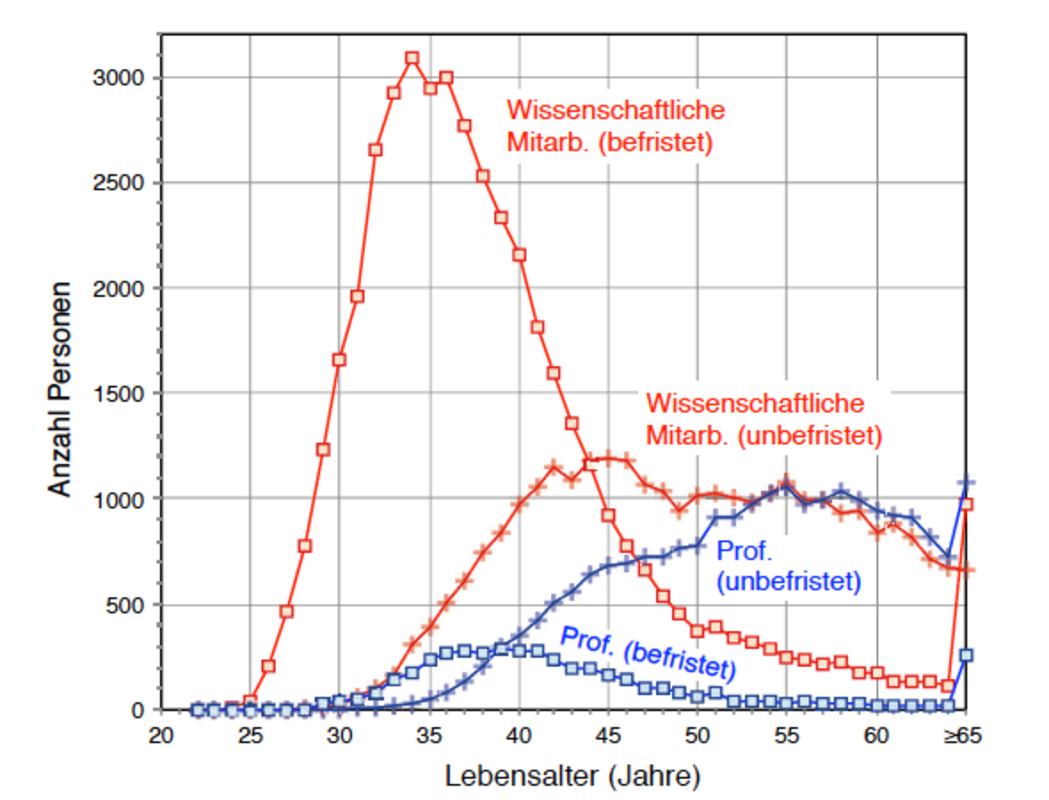
If this opportunity does not arise or cannot or will not be seized, there is an alternative at the university in the form of a position in the academic middle management. This can either be done thru a permanent employment contract or thru a series of multi-year contracts from the doctorate to retirement. The number of positions in the academic middle management is, however, also limited. According to the Federal Statistical Office, there are approximately 22,000 permanent professorships at German universities (about 370 in the geosciences) for around 74,000 research associates with completed doctorates. n. However, this includes fixed-term positions, and only about 29,000 of these employes are permanently employed (Source: BMBF; figures for 202 2). In total, about 28,000 people (approximately 230 in the geosciences) earn their doctorate in Germany each year, and about 1,500 permanent positions are newly filled (mid-level faculty and professorships; Fig. 1). The statistical chances for PhD holders to secure a permanent mid-level position and a professorship are roughly equal and together amount to about 5 percent of all PhD holders in a given year. of a cohort. Approximately 3,000 doctoral graduates from a cohort are initially employed in fixed-term positions, of which about half, between the ages of 35 and 45, secure one of the 1,500 permanent positions per year (Fig. 1). . 1).
The majority of the other half leave the university, with only about 1 percent of the PhD graduates remaining unemployed for an extended period. The median age at the completion of the doctorate is approximately 31 years, and the median age at the first appointment to a permanent professorship is approximately 41 years. Between obtaining a doctorate and becoming a professor, there are typically ten years of postdoctoral time, which in most cases is filled with fixed-term contracts of all kinds (assistant positions, project positions, scholarships). The initial appointment to a professorship from a permanent position in the middle level is rather the exception.
This current situation is now being criticized for several reasons. In the German university system, the tenure-track career is still not well established, so there is no clear career path. The appointment to a professorship for a research associate can only occur from another university, as a promotion within their own institute is considered an in-house appointment and is only rarely accepted. Due to the fixed-term regulations, the employe is also forced to leave the institute after the fixed-term contract expires. In practice, this means that either the opportunity for a professorship or the offer of a permanent position arises, or that by the end of one's 30s or early 40s, no further contracts are offered at a German university. f. The criticism here is that the long university experience is uninteresting for employers outside the university and that the individuals are therefore too old for the job market. are.
Exactly here is where the WissZeitVG, which came into force in 2007, was reformed in 2016, and is now presented as a draft bill in a new version, wanted to strike. In the currently applicable version of the law, the total duration of fixed-term contracts after obtaining a doctorate was limited to six years. This is now being shortened to four years in the new draft. Behind this lies an image that, in my opinion, has very little to do with the reality at universities. From the perspective of some political representatives, a talented young person should have demonstrated within four years after their doctorate that they belong to the aforementioned circle of the best minds by securing a permanent position during this time. From this perspective, it also follows that all employes who have not been offered a permanent position even after four years of postdoc time obviously do not belong to the best minds and should not continue to "clog" the system, as stated in the much-criticized Hanna video by the BMBF from 2018.
On the other hand, there are demands from the union side and from parts of the middle management itself, which call for the immediate permanent appointment of a large portion of the middle management positions by the universities. The number of fixed-term positions in the mid-level that could be made permanent, however, as mentioned above, is very small. Such a measure would somewhat alleviate the situation for the institutes and the staff, but it would not fundamentally reform it. A large part of the scientific staff is employed thru third-party funding within the framework of research projects, and the duration of their contracts is linked to the funding period of the respective project. No university will hire a third-party funded employe on a permanent basis in the hope that after the completion of one project, a new one will emerge, and so on, thus securing the funding permanently. would be. Therefore, the unions demanded that the basic funding of universities should be strengthened in order to provide more positions in the mid-level staff. could be financed, according to the unions, by reducing the research funds provided by the federal and state governments, as these are granted for a limited period and are therefore unfavorable to employes. are. I leave it to the reader to assess this proposal. I leave it to the reader to judge this proposal.
Personally, I did not perceive the possibility of being employed on fixed-term contracts after my PhD as a burden at the time, but rather as an expression of the freedom to still try out many things in my career as a scientist. What I, however, perceived as a threat was the inevitable end of this freedom imposed by the WissZeitVG, which comes with this law upon reaching the deadline. The combination of the lack of a tenure-track career path and the de facto professional ban imposed by the WissZeitVG has reinforced my decision to leave Germany after my doctorate. At American universities and research institutions, you encounter many talented individuals with similar backgrounds who were once trained at German universities. It is not to be expected that the further limitation of the postdoc phase to a maximum of four years thru a revised WissZeitVG will be a key factor for maintaining and expanding Germany's international competitiveness and innovative capacity, as the now available new draft suggests. will. On the contrary, it will rather motivate even more of the best minds to develop their talents in other countries or outside of universities. gen.
The BMBF calls the large proportion of fixed-term contracts at universities a misdevelopment and expresses disappointment that the currently valid version of the WissZeitVG has not put a stop to it. So now the regulation is to be drastically tightened: If too many research associates are employed in fixed-term positions, such employment is simply prohibited – problem solved.
The DVGeo and other scientific associations oppose the reduction of the maximum fixed-term period for postdocs to four years, but support the stronger establishment of tenure-track positions. Long-term, the situation at universities can surely only be improved by increasing the basic funding. In recent years, however, the proportion of third-party funding has constantly increased. in.
No one has been able to offer a perfect solution to the situation so far. It is clear that even in an optimized system, not all individuals who aspire to a long-term academic career will be able to realize it. The goal, however, must be to attract the most creative, talented, productive, and communicative people to the universities. I think we have spent too long focusing on how to push people out of the system whom we consider unsuitable, and have never really addressed the question of how to attract and retain people whom we consider suitable. ten. With the tightening of the WissZeitVG, I still do not see a departure from these traditions. In the Hanna video from the BMBF, the proposed solution was: "Innovation thru fluctuation." on".
— Your Horst Marschall