

Annual Meetings –Bringing Together Research,Exchange and Collaboration
Past conferences
Frankfurt EMC – 2012
In early September 2012, more than 800 mineralogists gathered at Johann Wolfgang Goethe University in Frankfurt for the first European Mineralogical Conference. To put it simply—the conference was fantastic! The number of conference participants, the venue, the consistently high quality of the presentations, the collaboration among the organizing European societies, the flawless organization, and the overwhelming hospitality of the German hosts—all of this gives us reason to hope that this joint European conference will be followed by others that are just as successful.
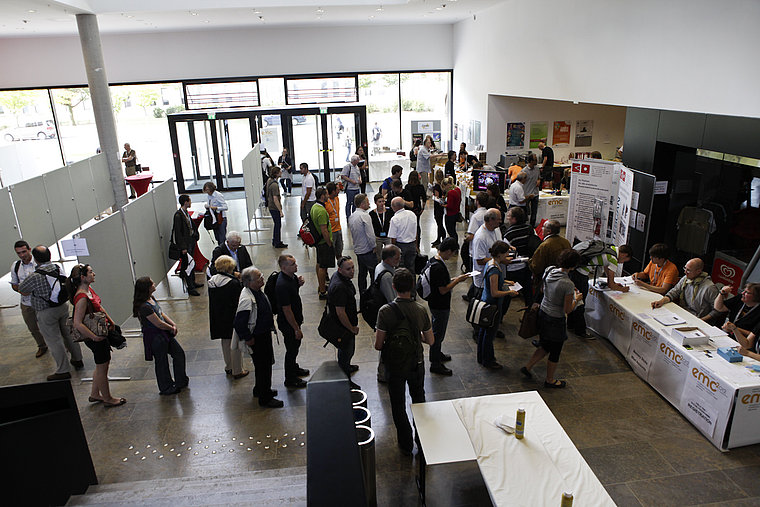
More than 800 mineralogists attended emc2012. Photo: Salar Baygan
A total of 33 scientific sessions were held under the following overarching themes: Mantle petrology and geochemistry, Magmatism and volcanology, Metamorphism, Applied mineralogy, Mineral physics, Mineralogical crystallography, Planetary materials, Mineral deposits and raw materials, Low-T geochemistry, Geochronology, Geobiochemistry, Advanced analytical techniques, and Archaeometry, care, and preservation. Particularly noteworthy was the high quality of the contributions by numerous doctoral students, both in oral presentations and in poster sessions. The latter were always very well attended, not least because of the refreshments provided by several industry sponsors. Many of the industry sponsors took the opportunity to demonstrate the latest developments in analytical technology to a broad audience of experts—we extend our heartfelt thanks for their outstanding support.
In addition to the scientific program, two field trips to the Eifel and the Odenwald, as well as a tour of the Rhine, were offered following the conference.
The conference was organized by a consortium of 10 European mineralogical societies—specifically, the German Mineralogical Society (DMG), the Mineralogical Society of Great Britain & Ireland (MinSoc), the Mineralogical Society of Finland (MinSocFin), the Austrian Mineralogical Society (ÖMG), the Mineralogical Society of Poland (PTMin), the Russian Mineralogical Society (RMS), the Sociedad Española de Mineralogía (SEM), the Société Française de Minéralogie et de Cristallographie (SFMC), the Società Italiana di Mineralogia e Petrologia (SIMP), and the Swiss Society of Mineralogy and Petrology (SSMP). Most of these societies held their annual meetings as part of emc2012 and opted not to hold separate events in their respective countries. The individual scientific sessions were organized by international teams to underscore the pan-European aspect of the conference.
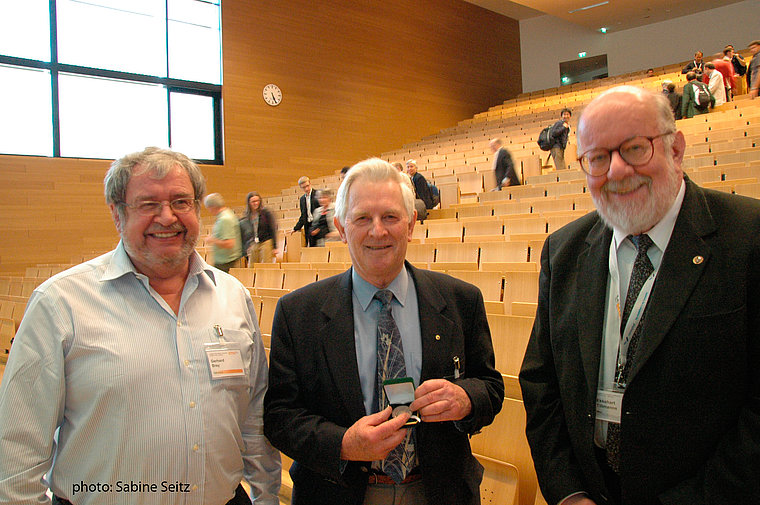
Among the highlights of the conference were undoubtedly the public evening lecture by Thomas Stachel on “Diamonds are forever—but when and where are they formed?” as well as plenary lectures by Hilary Downes on “Mantle and core formation viewed from meteorites,” Rod Ewing on “Roads not taken in nuclear waste disposal,” and Tim Elliot on “Tracing the mantle evolution with novel isotopic systems.” David Green received the IMA Medal and delivered a plenary lecture on the experimental petrology of peridotites. Many of the European societies presented their national awards during emc2012. The EMU Medal for outstanding research was awarded to Sébastien Merkel, who also delivered a plenary lecture. Our British colleagues presented their Schlumberger Prize to Simon Redfern, and the traditional Hallimond Lecture was delivered by Patrick O’Brien. He is the second Hallimond Lecturer from Germany, following Werner Schreyer (1987/88). Bernie Wood received the Abraham-Gottlob-Werner Silver Medal from the DMG for outstanding scientific achievements, and Dennis Harries was awarded the DMG’s Ramdohr Prize for the best presentation by a young scientist. The SIMP honored several doctoral dissertations.
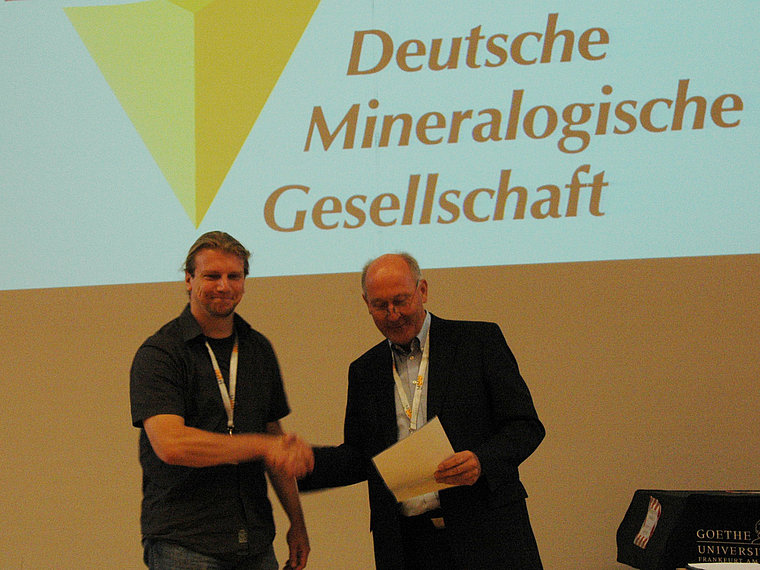
DMG President Rainer Altherr presents the Ramdohr Prize to Dennis Harries (Jena). Photo: Sabine Seitz
Most of the participating societies held their regular annual meetings in Frankfurt. In addition, the editors of *Mineralogical Magazine* and the *European Journal of Mineralogy* met. Likewise, the International Mineralogical Association (IMA) and the European Mineralogical Union (EMU) held several board meetings and delegate assemblies. All of these gatherings clearly highlight the advantages of a single international conference over multiple national meetings and point to a clear path forward.
In the past, some of the organizing societies had already joined forces to hold joint conferences—examples include the MAPT conference (Micro-Analysis, Processes, Time) in Edinburgh in 2009, organized by MinSoc and DMG, or the joint annual meeting of the ÖMG and the DMG in Salzburg in 2011, which had a focus on crystallography. In general, it seems that there are many (sometimes too many) highly interesting conferences throughout the year—and now, with the emc, another one has been added to the mix. However, this presents an opportunity to forgo holding our own annual conferences during emc years, thereby significantly lightening the conference calendar.
Gerhard Brey and Heidi Höfer were responsible for the conference in Frankfurt. Thanks to their flawless organization and warm hospitality, emc2012 was an outstanding success and will remain a fond memory for all participants. The non-German guests, in particular, will have fond memories of the local cuisine as well as German beer and wine. We all felt very welcome and would like to thank Heidi, Gerhard, and their team for their great work!
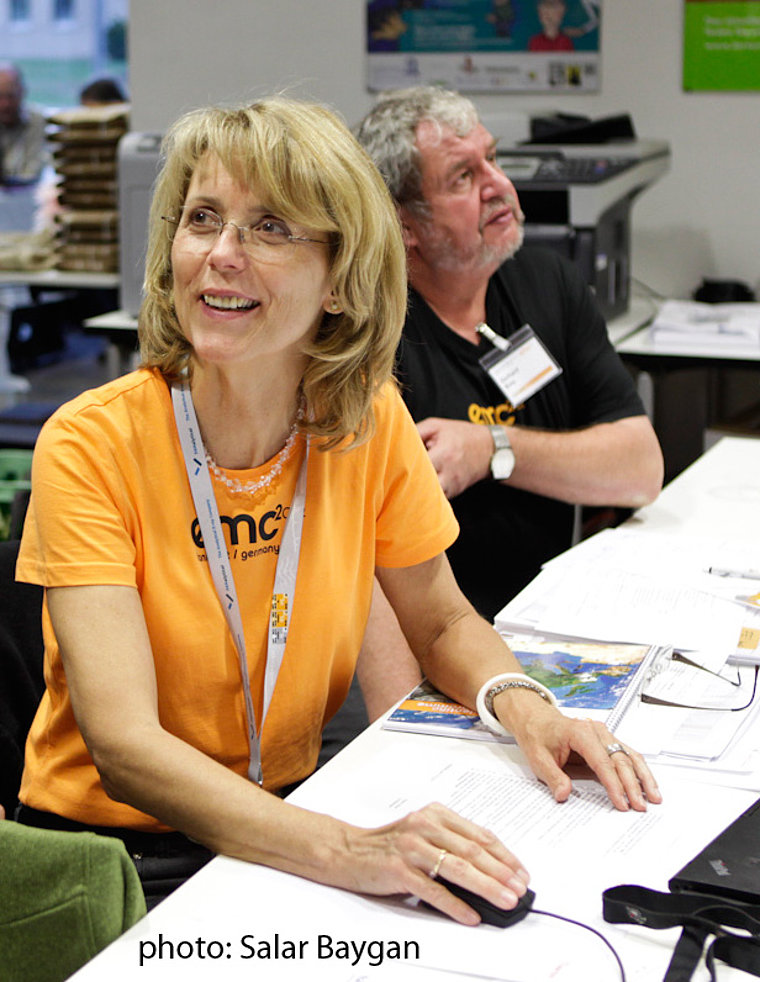
Heidi Höfer and Gerhard Brey, Photo: Salar Baygan
The success of the conference naturally raises the question of when the next such meeting will take place at the European level. Every four years, the international mineralogical community meets under the auspices of the IMA. In addition, there is the opportunity to present mineralogical content at international geological, geochemical, or geophysical conferences, as the boundaries between these disciplines are rather fluid. Nevertheless, the emc offers a unique forum at the European level for presenting new work to an international audience of mineralogists.
The ten societies that founded emc2012 have already decided to convene for the next emc in four years, in 2016. This meeting will take place in Italy; the “Società Italiana di Mineralogia e Petrologia” will host the event. Of course, other European mineralogical societies are cordially invited to participate in the next emc.
Kevin Murphy, Peter Treloar (MinSoc)
Jose Miguel Nieto (SEM)
Klaus-D. Grevel (DMG)